
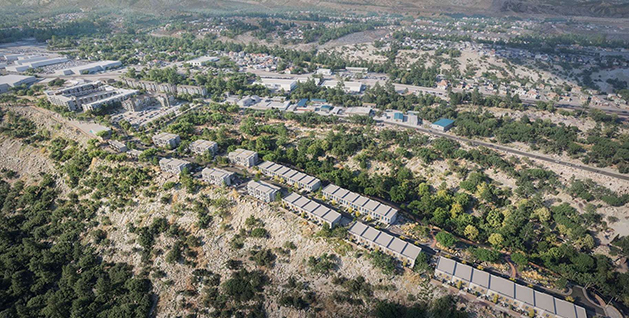
 A rendering of what a proposed apartment complex, located off DP Road, would look like. The apartment complex would be constructed on a parcel of land owned by Los Alamos County. The land would be sold to the developer. Courtesy/LAC
By KIRSTEN LASKEY
Los Alamos Daily Post
kirsten@ladailypost.com
There’s been a lot of focus on fulfilling the housing needs of the “missing middle” (those who fall somewhere in between low- and high incomes) in Los Alamos. With a new apartment complex being planned on County-owned land off DP Road, progress is being made to fill this gap.
Los Alamos County Council learned about this new housing project on a parcel of land dubbed A-8-A, during its regular meeting Aug. 26.
Housing and Special Projects Manager Dan Osborn provided an overview of the proposed apartment complex.
He explained the land is located around The Bluffs apartment and covers about 22 acres and approximately 18 acres are developable. The proposal is to sell the land for $5.5 million to the developer, Servitas. A $55,000 due diligence and earnest money deposit would be required.
In turn, the project will deliver 380 multi-family residential units, 260 of those will be market rate units comprising one-, two- and three-bedroom units, Osborn said. The remainder – 120 units – will be deed restricted for households earning between 60-100 percent of area medium income (AMI), with an average of 80 percent AMI.
These units will also be one-, two- or three-bedroom units and located throughout the development, he said. The County will purchase a permanent deed restriction of 88 of the 120 units for $5.5 million. This is an amount equal to the purchase price. These units will be comprised of 22 one-bedroom units, 44 two-bedroom units and 22 three-bedroom units. The remaining 32 deed restricted units will be acquired separately by the County as reimbursed pre-development expenses that will include things such as design, permitting fees and different studies across the project. Osborn reported that the costs for these deed restrictions and a maximum reimbursement will be $2 million. The rent restrictions on these units will become permanent once the full reimbursement has been paid. These will include eight one-bedroom units, 16 two-bedroom units and eight three-bedroom units for a total of 120 units.
To achieve the 80 percent of AMI requirement, Osborn said 40 of the units will be 60 percent AMI, 40 of the units will be 80 percent AMI, and 40 units will be 100 percent of AMI.
He reported that for rent, 40 units would be $1,800 a month, another 40 units will be $2,500 a month and the remaining 40 units will be $3,100. Osborn compared these rent prices to The Hill apartment complex which features market-rate units. At The Hill apartments, a one-bedroom apartment would be $2,500 and a three-bedroom would be $4,200.
“So, you can see we got some significant savings across all those unit types at 60- at 80- and at 100 percent AMI,” Osborn said. “What that shakes out to is that it equates to (the County investing in perpetuity) about $2,200 per bed, across those 120 units so that’s a pretty good value…”
While the proposed development on parcel A-8-A serves the “missing middle”, those who fall in the lower AMI brackets are left out.
In an email to the Los Alamos Daily Post Wednesday, Osborn went into more detail about who will benefit from the housing project.
“The A-8-A project is a mixed-income development specifically designed to provide ‘missing middle’ housing, he wrote. “The ‘missing middle’ refers to moderate-income households; individuals who earn too much to qualify for low-income housing but too little to afford the high cost of market-rate homes in Los Alamos. As highlighted in the County’s adopted plans … Los Alamos needs new, higher-density housing in compact neighborhoods. The 120 deed-restricted units are for households earning between 60 percent and 100 percent of the Area Median Income (AMI), a demographic that includes many teachers, public safety workers, and small business employees who are often priced out of the local market.”
Regarding those earning lower incomes, Osborn said in his email that the Los Alamos County has other initiatives specifically for these households.
He pointed out the County recently increased the number of permanently affordable housing units by approximately 33 percent by acquiring deed restrictions on 87 studio units at the 9th Street Apartments. These units are available to households earning at or below 45 percent AMI.
The Canyon Walk and Bluffs (senior) apartments have added an additional 134 deed-restricted units for residents making between 30 percent and 60 percent AMI, Osborn said in his email. Plus, he said “by adding a significant supply of market-rate and ‘missing middle’ housing, the project helps to alleviate market-wide pressures that drive up all housing costs. When the overall supply of housing increases, it can help to stabilize or lower rents, benefiting households across all income levels.”
Still, if a person is making minimum wage, they need to do more work to get help – in the form of applying for federal assistance such as Housing Choice Vouchers. Osborn noted that the 9th Street Apartments, Canyon Walk Apartments and The Bluffs accept these vouchers.
He said he encourages anyone seeking housing to visit the Los Alamos County Housing webpage to learn more about AMI’s, programs, and assistance, including how to contact the Santa Fe Civic Housing Authority to access Housing Choice Vouchers.
Work to get the A-8-A land developed began back in July 2024, according to Osborn’s report to Council when a solicitation of proposals was issued. Servitas was selected in November 2024.
What Servitas is proposing to do satisfies all the County’s codes and building regulations and checks off a lot of boxes in numerous County plans including the Los Alamos Housing Market Needs Analysis and the Affordable Housing Plan, Osborn added.
“The needs analysis specifically identifies the A-8-A parcel as appropriate for higher densities and calls for over 370 units on the parcel with the density of up to 17 units per acre,” he said. “This recommendation is further supported in the Affordable Housing Plan, which calls for missing middle, compact, efficient, and higher density housing types required to meet our housing goals. This proposal addresses and identifies the need for mixed income development combining market rate and affordable units, which would then be reserved for targeted incomes.”
Councilor Beverly Neal-Clinton asked how does the County’s investment of $7.5 million for permanent rent restrictions on the 120 units – split between $5.5 million for the main chunk and up to $2 million for the additional units translate into long-term cost efficiency for affordable housing?
Osborn said the long-term investment is $2,200 per bedroom but the value would actually be greater since it would be a brand-new development and serving a mix of income levels.
Councilor Melanee Hand asked about the impacts the apartment complex’s construction would have on existing residences and businesses.
Osborn said the project would not require any major utility upgrades and outreach will be done specifically to minimize the impacts on DP Road.
The project will be returning to Council. A draft development agreement and introduction of ordinance is scheduled to be on the Sept. 9 meeting agenda and a public hearing and possible adoption is scheduled to occur Sept. 30.